Bosu ball exercises
A Bosu ball is a type of balance trainer designed to create controlled instability during movement. It looks like a half exercise ball, with a rounded dome on one side and a flat platform on the other. That unstable surface is the reason bosu ball exercises are widely used in physiotherapy ball exercises, sports rehab, and balance training programs.
In rehabilitation, instability is not about making exercises harder. It is about teaching the body how to respond, stabilise, and stay aligned under load. When used correctly, bosu ball exercises for balance can improve coordination, joint awareness, and control that carries over into daily activities and sports.
These exercises are suitable for a wide range of people in Sydney. Active adults, desk workers, older adults, recreational athletes, and people recovering from injury often use balance ball exercises as part of guided programs. The focus is always the same. Control comes before intensity.
What Is a Bosu Ball and How Does It Work?
A Bosu ball is essentially a half-balance ball fixed to a rigid base. The dome side compresses and shifts when you load it, while the flat side offers a more stable but still challenging surface.
This design turns simple movements into balance trainer exercises by forcing your body to constantly adjust. The ankles, knees, hips, and trunk all work together to keep you upright. This is why Bosu exercises are often more demanding than floor-based movements, even when the exercise itself looks simple.
From a physiotherapy perspective, half-ball exercises challenge:
- Balance and postural control
- Proprioception, which is your joint position awareness
- Core engagement during movement
- Neuromuscular control, especially timing and coordination
You will see Bosu balls in gyms alongside exercise ball workouts and fitness ball exercises, but their most effective use is often within structured rehab or injury prevention programs.
If exercises alone are not enough, our physiotherapists in Bondi Junction and Maroubra can assess your condition and tailor treatment to your needs.
Why Physiotherapists Use Bosu Ball Exercises
Physiotherapists in Sydney use Bosu balance exercises to bridge the gap between basic strength and real-world movement. Many injuries happen when the body cannot control the load on one leg, during rotation, or when reacting to unexpected forces. A half-ball workout can expose these weaknesses in a controlled setting.
In clinical practice, Bosu ball workouts are used to support balance retraining, injury prevention, and later-stage rehabilitation. They help improve joint stability after ankle sprains, knee injuries, and hip problems. They are also useful in post-surgical rehab once pain has settled and movement restrictions have eased.
Unlike general exercise with gym ball routines, physiotherapy-led bosu exercises focus on alignment, quality of movement, and appropriate progression. The goal is not fatigue. The goal is control that transfers to walking, running, lifting, and sport.
Safety and Setup Before You Start
Learning how to use a bosu ball correctly is essential. The setup you choose will determine how challenging and safe the exercise is.
Using the bosu with the flat side down is usually the best starting point. This creates a more predictable surface and suits beginners, older adults, and people new to balance ball workouts. Placing the dome side down increases instability and should only be done when balance and strength are already well developed.
Foot and hand placement matter. Staying close to the centre of the dome gives you the most control. Uneven pressure or gripping with the toes often leads to poor alignment higher up the chain.
Shoes can improve grip and comfort, especially for bosu ball leg exercises. Barefoot training may improve foot awareness, but it also increases demand and should be introduced gradually.
Common mistakes include moving too fast, holding breath, allowing knees to collapse inward, or turning the exercise into a wobble challenge. If control is lost, the exercise should be modified or paused.
People with acute pain, severe balance deficits, or early post-surgical restrictions should avoid balancing ball exercises without professional guidance.
Core Bosu Ball Exercises and Clinical Purpose
Single-Leg Hold
This is one of the most effective Bosu ball balance exercises for building lower limb control. Standing on one leg on the dome challenges the ankle, hip, and trunk simultaneously. It is often used in rehab for ankle instability, knee control issues, and general balance decline.
The focus is on standing tall, keeping the pelvis level, and maintaining steady breathing. Loss of alignment usually shows up quickly, making this a valuable assessment and training tool.
Bird Dog
Bird dog movements on a bosu ball increase the demand on trunk stability. This half stability ball exercise trains the body to keep the spine steady while arms and legs move, which is essential for safe lifting and reaching.
It is commonly used in physiotherapy for people rebuilding control after back pain or prolonged inactivity.
Bridge
Bridging with feet on a bosu ball turns a basic exercise into a balance ball core exercise. The unstable surface forces the hips and trunk to work together, improving posterior chain strength and pelvic control.
This variation is often introduced after floor bridges feel easy and pain-free.
Mountain Climber
Mountain climbers on a Bosu ball combine Bosu ball core exercises with dynamic control. They challenge shoulder stability, trunk stiffness, and hip movement under speed. These are more suitable for later-stage rehab or conditioning rather than beginners.
Burpee
A Bosu ball burpee is a demanding Bosu workout that integrates strength, balance, and coordination. In physiotherapy, this is only used when joints tolerate impact and movement quality remains high. It is not a starting exercise.
Forward Lunge
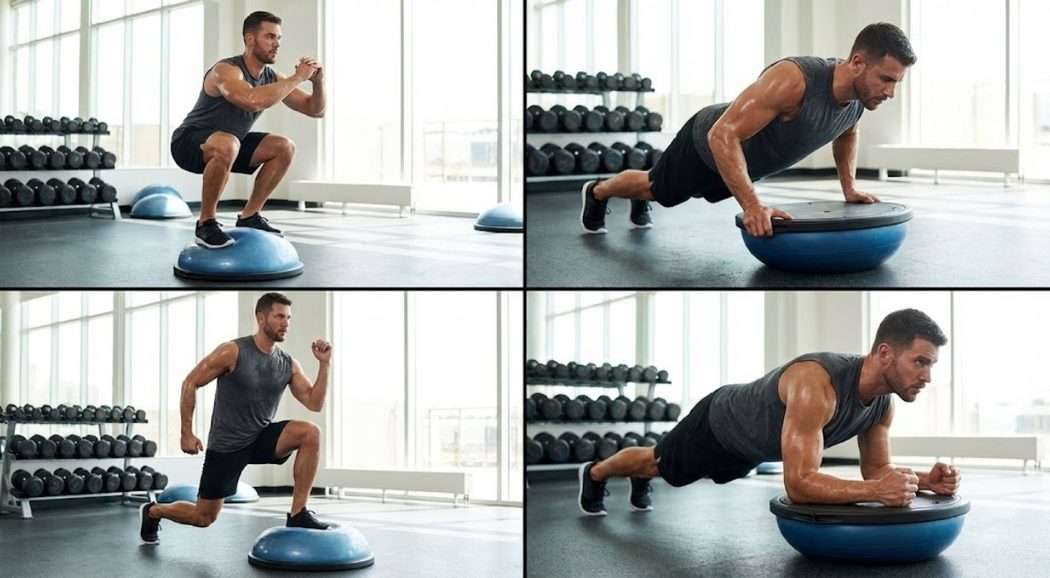
Bosu ball lunges place a high demand on single-leg control. Stepping onto the unstable surface highlights knee alignment, hip stability, and balance reactions. Unlike Lunges, this is useful for return-to-running or sport preparation when done slowly and with good form.
V Squat
A V squat on the bosu challenges ankle and hip strategy during squatting. This half ball exercise helps identify compensations that may not appear during standard squats.
Side-to-Side Squat
This lateral balancing ball workout trains control during side-stepping and direction changes. It is often relevant for sports and daily activities that involve lateral movement.
Push-Up
Push-ups on a Bosu ball increase shoulder and trunk demands. These Bosu ball stability exercises help improve scapular control and core stiffness, especially when shoulder pain has settled.
Triceps Dip
Triceps dips on a Bosu ball load the arms and shoulders while requiring balance. They should be approached carefully and avoided if shoulder discomfort is present.
Seated Oblique Twist
This is one of the more challenging Bosu ball ab exercises. Sitting on the dome while rotating train trunk control and coordination. It suits people with good baseline core strength and no acute back pain.
If exercises alone are not enough, our physiotherapists in Bondi Junction and Maroubra can assess your condition and tailor treatment to your needs.
Who Benefits Most from Bosu Ball Exercises?
Desk workers often develop poor balance and reduced joint awareness from prolonged sitting. Balance ball workouts can help restore coordination and confidence during standing and walking tasks.
Older adults may benefit from carefully selected half-ball balance exercises for beginners, focusing on safety and gradual progression to support fall prevention.
Athletes and active adults use Bosu workouts to refine control during sport-specific movements and reduce injury risk.
People in post-injury or post-surgical rehab may use physiotherapy ball exercises once cleared, helping rebuild proprioception and stability that basic strength work alone may not address.
Physiotherapy-Led Use at Invigor Health
At Invigor Health, Bosu ball exercises are used as part of structured physiotherapy programs rather than standalone workouts. Our physiotherapists in Bondi Junction & Maroubra clinics make sure each person is assessed for strength, balance, joint control, and movement patterns before unstable exercises are introduced. This ensures the Bosu ball exercise chosen matches the stage of recovery and individual goals.
Progression is planned carefully. The aim is to improve functional movement, reduce reinjury risk, and support long-term resilience rather than chasing intensity. This physiotherapy-led approach helps ensure Bosu balance trainer exercises remain effective, safe, and relevant to everyday life.
If exercises alone are not enough, our physiotherapists in Bondi Junction and Maroubra can assess your condition and tailor treatment to your needs.
Exercise For You
Strengthening Exercises
Flexibility and Mobility Exercises
Stability and Balance Exercises
Rehabilitation and Injury-Specific
Posture and Core Activation
Neurological Rehabilitation Exercises
- Rowing Machine
- Tai Chi for Balancing
- Heel-to-Toe Walking
- Motor Control Exercises
- Coordination Drills
Post-Surgical Rehabilitation
- Shoulder External Rotation
- Hip Replacement Exercises
- Knee Replacement Rehabilitation
- Ankle Mobilizations
Breathing and Relaxation Exercises
- Diaphragmatic Breathing
- Pursed Lip Breathing
- Box Breathing
Pilates and Stability Exercises
- Pilates Leg Circles
- Pilates Roll-Ups
- Plank Variations
- Bridge with Marching
Frequently Asked Questions
Are bosu ball workouts effective?
Bosu ball workouts can be effective for balance, stability, and control when used with good technique and appropriate progression.
What exercises can you do on a bosu ball?
You can perform balance holds, lunges, squats, core exercises, upper body support work, and controlled conditioning movements.
How long should you balance on a Bosu ball?
Most people start with 20 to 30 seconds per set, focusing on steady control rather than duration.
What are the disadvantages of the bosu ball?
Poor technique, rushing movements, or using it too early in rehab can increase injury risk and reduce effectiveness.
What is the number one exercise for aging?
Exercises that improve balance and strength together, such as controlled single-leg work, are among the most valuable for healthy aging.