Knee extension exercise
What Is Knee Extension?
Knee extension is the movement where the knee straightens from a bent position.
In simple terms, it means to extend the knee joint so the leg moves from flexion into an extended knee position.
The extension of the knee can occur actively, when muscles generate force to straighten the leg, or passively, when the knee is moved into extension without muscle effort. Active knee extension ROM is especially important for strength, control, and daily function, and is routinely assessed during physiotherapy consultations at Invigor Health.
Clinically, knee extension is often discussed alongside knee flexion and extension, as both movements must work together for smooth, pain-free motion. Limitations in knee extension range of motion or strength can significantly affect walking, standing, and balance, and are common findings during knee assessments in clinical practice.
If exercises alone are not enough, our physiotherapists in Bondi Junction and Maroubra can assess your condition and tailor treatment to your needs.
Quadriceps Anatomy and Role in Knee Extension
The primary muscle group that extends the knee is the quadriceps femoris.
This powerful group forms the bulk of the front of the thigh and is responsible for most extension at the knee.
The quadriceps consist of four primary muscles that extend the knee:
- Vastus medialis
- Vastus lateralis
- Vastus intermedius
- Rectus femoris
The three vasti arise from the femur, while the rectus femoris originates from the hip bone. Together, these knee extensor muscles converge into the quadriceps tendon, attach to the patella, and continue to the lower leg.
Functionally, the quadriceps are the prime mover of knee extension. They act as the agonist during extension of the knee joint, while muscles such as the ITB and TFL assist as stabilising synergists, particularly near full knee extension.
When people ask which muscle group extends the knee or what muscles extend the knee, the answer is the quadriceps working as a coordinated unit.
Why Knee Extension Strength Matters
Adequate knee extension strength is essential for everyday movement. Activities such as walking, climbing stairs, standing up from a chair, and controlling descent when walking downhill all rely on strong knee extensors.
From a stability perspective, knee extension plays a key role in both static and dynamic balance. Reduced strength in the extensors of the knee joint is linked with poorer balance test performance and increased instability.
In sport, knee extension and flexion are critical for running, cycling, jumping, kicking, and rapid direction changes. Athletes with weak knee extensors often struggle with force production and control.
Knee Extension in Rehabilitation
In rehabilitation settings, restoring knee extension ROM and strength is often a priority. After knee injuries or surgery, pain and swelling can inhibit quadriceps activation, even when the muscles themselves are healthy.
A common clinical issue is extension lag, also known as extensor lag or quadriceps lag. This occurs when a person can achieve full knee extension passively but cannot actively extend the knee through the same range.
Persistent extensor lag affects gait, increases joint stress, and delays recovery. Early attention to knee extension in rehab helps normalise movement and reduces compensatory patterns.
Biomechanics and Load Considerations
The biomechanics of extension of the knee joint depend on joint angle and load. As the knee moves from flexion toward full extension, forces across the patellofemoral joint increase.
Poor control or excessive resistance during knee extensions can raise patellofemoral contact pressures and increase subchondral bone stress. This is why load management is critical when training the muscles involved in knee extension.
Hamstring flexibility also influences knee mechanics. Tight hamstrings can increase the knee flexion moment during gait, altering how the quadriceps must work to extend the leg at the knee.
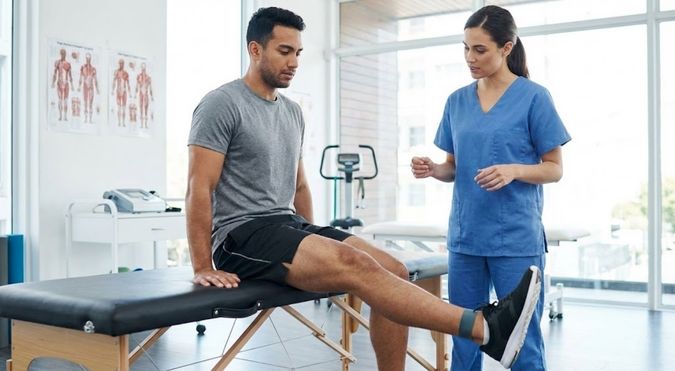
Assessment Factors Clinicians Consider
Assessment of knee extension goes beyond isolated strength testing. Clinicians consider patient history, symptom behaviour, and functional complaints alongside physical measures.
Key factors include knee extension range, side-to-side differences in knee extension ROM, gait pattern, stride length, and the relationship between knee flexion and extension during walking.
Muscle length tests such as the straight leg raise or sit-and-reach help determine whether hamstring tightness is influencing the ability to fully extend the knee. Gluteal extensor strength and overall movement strategy are also reviewed.
If exercises alone are not enough, our physiotherapists in Bondi Junction and Maroubra can assess your condition and tailor treatment to your needs.
How Knee Extension Exercises Are Used in Physio Programs
Knee extension exercises are used to restore strength, coordination, and confidence in the knee joint.
They target the knee extensor muscle group when weakness, inhibition, or poor control is present.
Progression focuses on gradually increasing load and range while respecting symptoms. The goal is to improve knee extension definition in functional tasks, not just isolated movement.
These exercises are integrated with other interventions that address hip strength, flexibility, balance, and overall knee flexion and extension control.
Common Mistakes and Misunderstandings
One frequent issue is loading the knee too aggressively during knee extension work. Excessive resistance can irritate the joint and worsen symptoms.
Another misunderstanding is focusing only on strength without considering movement quality or range. Improving knee extension degree without addressing biomechanics often leads to incomplete recovery.
Ignoring pain signals or repeatedly locking into end-range extension without control can also be problematic.
When to Seek Physiotherapy Guidance
Physiotherapy support is recommended if you struggle to fully extend the knee, experience persistent pain, or notice weakness during daily activities.
This is particularly important after surgery, when restoring full knee extension degrees is critical for long-term outcomes. Ongoing knee extension lag, reduced confidence, or altered gait should not be ignored.
At our Invigor Health physio clinic in Bondi Junction, knee extension is assessed as part of a comprehensive lower limb evaluation. Treatment focuses on restoring normal extension of the knee, improving strength in the knee extensors, and supporting safe, long-term recovery through individualised rehabilitation
If exercises alone are not enough, our physiotherapists in Bondi Junction and Maroubra can assess your condition and tailor treatment to your needs.
Exercise For You
Strengthening Exercises
Flexibility and Mobility Exercises
Stability and Balance Exercises
Rehabilitation and Injury-Specific
Posture and Core Activation
Neurological Rehabilitation Exercises
- Rowing Machine
- Tai Chi for Balancing
- Heel-to-Toe Walking
- Motor Control Exercises
- Coordination Drills
Post-Surgical Rehabilitation
- Shoulder External Rotation
- Hip Replacement Exercises
- Knee Replacement Rehabilitation
- Ankle Mobilizations
Breathing and Relaxation Exercises
- Diaphragmatic Breathing
- Pursed Lip Breathing
- Box Breathing
Pilates and Stability Exercises
- Pilates Leg Circles
- Pilates Roll-Ups
- Plank Variations
- Bridge with Marching
Frequently Asked Questions
What is the normal knee extension?
Normal knee extension is 0 degrees, meaning the knee can fully straighten.
What are the 4 muscles involved in knee extension?
The four muscles are vastus medialis, vastus lateralis, vastus intermedius, and rectus femoris.
What are the 4 muscles that extend the knee?
The quadriceps muscle group extends the knee, made up of those four muscles.