Bracing techniques exercises
If your lower back keeps “tweaking” when you lift, train, or even get out of the car, the issue is often not weakness — it is poor core stability and movement control.
At Invigor Health Sydney Eastern Suburbs Physio clinic, we regularly see patients who:
- Do plenty of sit-ups and planks
- Train hard at the gym
- Run weekly
- Yet still get recurring lower back pain
The missing link is often abdominal bracing — a skill that protects your spine, improves performance, and builds long-term resilience.
Let’s break down exactly what is bracing in exercise, how to do it correctly, and which core bracing exercises actually work.
If exercises alone are not enough, our physiotherapists in Bondi Junction and Maroubra can assess your condition and tailor treatment to your needs.
What Is Bracing in Exercise?
In simple terms, bracing is the coordinated activation of your deep abdominal muscles to create spinal stability during movement.
Your trunk functions like a cylinder:
- The diaphragm forms the top
- The pelvic floor forms the base
- The abdominal wall wraps around the sides
- The spinal stabilisers support the back
When these muscles contract together, they create intra-abdominal pressure. This pressure increases spinal stiffness and protects the lumbar spine from excessive movement.
- It is not sucking your stomach in.
- It is not pushing your belly out aggressively.
- It is controlled, 360-degree trunk tension.
Why Bracing the Core Matters
Without proper bracing the core, small uncontrolled movements occur in the spine. Over time, this can contribute to:
- Disc bulges
- Facet joint irritation
- Recurrent muscular spasms
- Chronic mechanical back pain
Bracing improves:
- Core stability
- Neuromuscular coordination
- Load tolerance
- Postural control
- Injury prevention
At Invigor Health, our approach is not endless “maintenance” treatment. We focus on identifying the root cause and restoring function long-term.
Bracing is often the foundation.
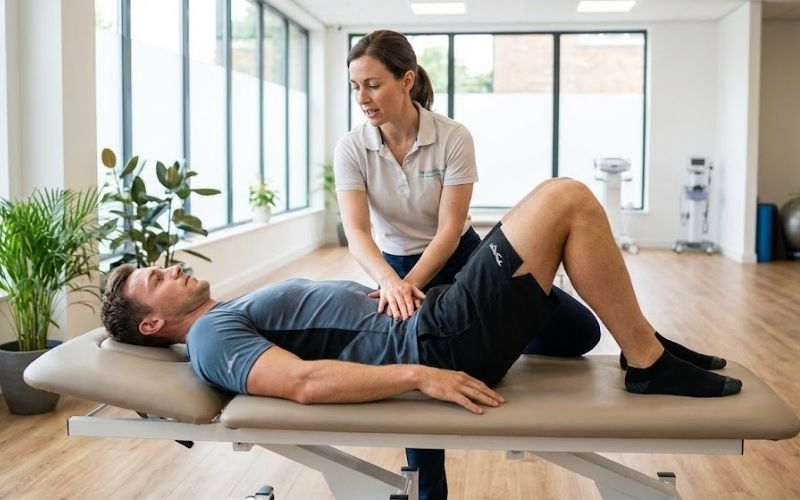
When Should You Use Abdominal Bracing?
Abdominal bracing is not something you hold all day.
You use it during load or stress.
Examples include:
- Lifting groceries
- Picking up your child
- Deadlifting
- Squatting
- Sprinting
- Carrying heavy bags
- Getting up from the floor after surgery
Athletes are trained to brace before explosive movement. This improves power output and reduces injury risk.
At our Bondi Junction clinic, where many patients are active gym-goers and runners, proper bracing often resolves ongoing back irritation that strength training alone has not fixed.
Core Bracing Exercises You Can Start Today
Once you understand the technique, you can build control with structured core bracing exercises.
Beginner Bracing Exercise
- Supine brace holds
- Practice maintaining tension with steady breathing
Intermediate Core Bracing Exercises
- Dead bug
- Bird dog
- Side plank
Advanced Core Bracing Exercises
- Modified plank
- Pallof press
- Farmer carries
Each bracing exercise should maintain neutral spine and controlled breathing. The goal is coordination, not just strength.
Shoulder Bracing Exercises and Upper Body Stability
Many people overlook the link between trunk stability and shoulder performance. Proper shoulder bracing exercises involve trunk activation during:
- Overhead pressing
- Push-ups
- Pull-ups
- Carrying loads
When the core is not stabilised, excessive strain transfers to the shoulder joint.
For athletes and gym-goers in Sydney, improving bracing often enhances both shoulder strength and injury prevention.
Bracing for Athletes and Gym Training
If you train in CrossFit, lift weights, or play sports, bracing becomes performance-critical. Proper bracing:
- Improves force transfer
- Enhances squat and deadlift stability
- Protects during rotational sports (tennis, rugby)
- Reduces overload in sprinting and jumping
Ryan Dorahy, our principal physiotherapist in Bondi Junction, has worked with elite sporting teams, including rugby league and basketball. In high-performance environments, spinal control is trained deliberately — not left to chance.
The same principles apply to everyday athletes in Sydney.
When to See a Physiotherapist
Consider booking an assessment if you:
- Have recurring back pain
- Feel unstable during lifting
- Are you returning from surgery
- Train regularly but still get flare-ups
- Are unsure if your core exercises are effective
At Invigor Health, we provide:
- Physiotherapy
- Movement screening
- Running assessments
- Sports rehabilitation
- Post-surgical rehab
- Telehealth options
No referral is required. We accept private health insurance and Medicare EPC plans where eligible.
Summary:
Abdominal bracing is not just a rehab drill. It is a foundational movement skill.
When trained correctly, it:
- Protects your spine
- Reduces recurring back pain
- Improves athletic performance
- Supports safe post-surgical recovery
- Builds long-term resilience
If you are based in Bondi Junction or looking for physio in Maroubra, you are at right page. and want to learn how to use your core properly, our team can guide you through a personalised, evidence-based plan.
Book your assessment and let’s future-proof your spine.
If exercises alone are not enough, our physiotherapists in Bondi Junction and Maroubra can assess your condition and tailor treatment to your needs.
Exercise For You
Strengthening Exercises
Flexibility and Mobility Exercises
Stability and Balance Exercises
Rehabilitation and Injury-Specific
Posture and Core Activation
Neurological Rehabilitation Exercises
- Rowing Machine
- Tai Chi for Balancing
- Heel-to-Toe Walking
- Motor Control Exercises
- Coordination Drills
Post-Surgical Rehabilitation
- Shoulder External Rotation
- Hip Replacement Exercises
- Knee Replacement Rehabilitation
- Ankle Mobilizations
Breathing and Relaxation Exercises
- Diaphragmatic Breathing
- Pursed Lip Breathing
- Box Breathing
Pilates and Stability Exercises
- Pilates Leg Circles
- Pilates Roll-Ups
- Plank Variations
- Bridge with Marching