Wobble board exercises
The wobble board exercise is a structured balance training method used in physiotherapy, rehabilitation settings, and athletic conditioning programs.
It involves standing and weight-bearing exercises performed on an unstable surface, designed to challenge balance, coordination, and joint control—especially around the ankles.
At Invigor Health, wobble board training is commonly used to support ankle rehabilitation, injury prevention, and long-term balance confidence for people of all ages across Sydney, including Bondi Junction, Maroubra, and the Eastern Suburbs.
Here we’ve explained how wobble board work, who they are for, how to perform them safely, and how they fit into physiotherapy-led care.
What is a wobble board?How is it different from other balance boards?
A wobble board is a type of balance board exercise used as a fitness and rehabilitation tool.
It has a flat top surface to stand on and a rounded or dome-shaped base underneath. This design allows the board to move in multiple directions, creating controlled instability.
Balance boards, wobble boards, and rocker boards explained
- Wobble boards move side-to-side, front-to-back, and in circular patterns often called “around the world.”
- Rocker boards usually move in one primary direction only, depending on their shape.
Because wobble boards allow movement in all directions, they demand greater coordination and joint control. Rocker boards are often easier to start with, especially early in rehabilitation.
Why unstable surfaces change training effect
Standing on an unstable surface forces the body to make constant, small adjustments.
This activates the muscles, ligaments, and tendons around the ankle, while also engaging the calves, quads, hamstrings, glutes, and core muscles.
The result is improved stability, better joint awareness, and improved control during everyday movement and sport.
If exercises alone are not enough, our physiotherapists in Bondi Junction and Maroubra can assess your condition and tailor treatment to your needs.
Why wobble board training works for balance and injury prevention
The balance systems that keep you upright. Balance depends on three systems working together:
- The visual system, which helps you orient to your surroundings
- The vestibular system, which senses head movement and position
- The proprioceptive system, which detects body position and movement in three-dimensional space
Wobble board training specifically improves proprioception, your body’s ability to sense where joints are and how they are moving.
Why ankles matter
The ankle plays a critical role in balance.
After an ankle sprain, proprioception often becomes impaired, even after pain settles.
Wobble board exercises retrain coordination and strength in the lower leg, including the peroneal muscles, which help control ankle stability during uneven or unexpected movement.
Who benefits most
Wobble board exercises are commonly used for:
- People recovering from ankle sprains
- Those with recurrent ankle instability
- Athletes preparing for return to sport
- Older adults working on balance confidence
- People aiming to reduce falls risk
Benefits You Can Expect
With appropriate progression, the balance board workout can be highly beneficial. Here are some balance board benefits:
- Improve standing balance and coordination
- Strengthen muscles around the ankle
- Support better posture during standing tasks
- Improve lower limb control and joint awareness
- Contribute to injury prevention when part of a broader program
Calories and weight loss: keep expectations realistic
Balance board workouts may increase energy expenditure compared to sitting or standing on a stable surface.
This can contribute to daily calorie use, depending on intensity, duration, and body weight.
However, wobble board exercises are not designed as a primary weight-loss method. Their main role is balance, control, and injury risk reduction.
How to do wobble board exercises safely
Set-up and safety checks
- Clear the area around the board
- Wear stable footwear or go barefoot if appropriate
- Place the board near a wall or table for support
- Step off rather than trying to “save” a loss of balance
Starting stance
- Feet hip-width apart, placed near the outer edges of the board
- Knees soft, not locked
- Neutral spine, upright posture
- Eyes forward, focusing on a fixed point
Key cues for good form
- Move slowly and with control
- Let the ankles guide the movement
- Keep the upper body relaxed
- Breathe normally
Common mistakes
- Moving too fast
- Slamming the board edges into the floor
- Locking the knees
- Gripping the toes excessively
- Pushing through pain
Who it suits
Wobble board exercises suit people working on balance, ankle control, coordination, and sport readiness when progressed appropriately.
Who should avoid or modify
Extra care is needed if you have:
- Acute ankle, knee, or hip pain
- Significant balance limitations
- Recent surgery without clearance
- Dizziness or high fall risk
When to stop
Stop the exercise if you experience:
- Sharp or worsening pain
- Dizziness or nausea
- Repeated near-falls
- Swelling or joint irritation after sessions
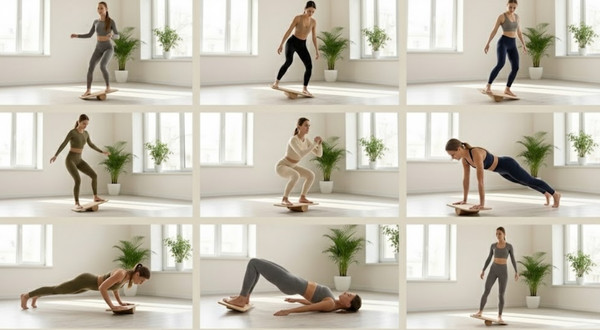
Wobble board exercises: from basic to harder
Here are some exercises that can help you with the wobble board.
Basic balance sequence
Begin with:
- Holding a steady stance without edges touching the floor
- Slow front-to-back tilts
- Controlled side-to-side motion
The goal is smooth, controlled movement.
“Around the world” circles
Create small circular movements, gradually increasing size while maintaining control.
Mini squats
Perform shallow squats while staying centred on the board. Knees should track over the feet, and movement should remain slow.
Upper body and core options
- Plank with hands on the board for core and shoulder stability
- Push-ups only if plank control is already strong
These significantly increase difficulty and are not suitable for everyone.
Glute bridge
Lie on your back with feet on the board. Lift the hips while keeping the pelvis level and stable.
Progressions and regressions
How to make it easier
- Use wall or table support
- Reduce movement range
- Shorten hold times
- Choose a rocker board instead
How to progress safely
- Narrow the stance
- Increase duration gradually
- Add a gentle head turn.
- Progress from eyes open to eyes closed only when safe
- Add light-reaching tasks
Progress one variable at a time.
Rehabilitation Focus: Physiotherapy-led Care
Ankle sprain rehab and recurrent sprain prevention
Wobble board training is widely used in physiotherapy to restore ankle proprioception after sprains. Progression typically moves from supported balance to multi-directional control and later sport-specific demands.
Post-surgical or persistent pain cases
In post-surgical or complex cases, wobble board exercises are introduced only when appropriate and tailored to individual capacity.
Older adults and falls risk
When supervised and appropriately progressed, wobble board exercises can improve standing balance and confidence in older adults.
Sport readiness and conditioning programs
For athletes, wobble board work supports ankle control and coordination but complements—not replaces—strength, running mechanics, and sport-specific drills.
If exercises alone are not enough, our physiotherapists in Bondi Junction and Maroubra can assess your condition and tailor treatment to your needs.
Drawbacks and safety issues
Wobble boards require balancing on an unstable surface, which increases fall risk if used incorrectly. They may irritate painful ankles, knees, or hips if progressed too quickly.
Seek physiotherapy advice if balance feels unsafe, pain persists, or ankle sprains keep recurring.
Choosing the right board
Wobble board vs rocker board
- Wobble boards allow multi-directional and circular movement and suit later-stage rehab or advanced training.
- Rocker boards move in one direction and are often easier for beginners or early rehab.
Starting with a more stable option is often safer.
Physiotherapy support at Invgior Health
Physiotherapists can assess balance control, ankle stability, and movement quality to guide safe wobble board progression.
Invigor Health provides expert physiotherapy services in Bondi Junction and Physio care in Maroubra, with telehealth options also available.
Exercise For You
Strengthening Exercises
Flexibility and Mobility Exercises
Stability and Balance Exercises
Rehabilitation and Injury-Specific
Posture and Core Activation
Neurological Rehabilitation Exercises
- Rowing Machine
- Tai Chi for Balancing
- Heel-to-Toe Walking
- Motor Control Exercises
- Coordination Drills
Post-Surgical Rehabilitation
- Shoulder External Rotation
- Hip Replacement Exercises
- Knee Replacement Rehabilitation
- Ankle Mobilizations
Breathing and Relaxation Exercises
- Diaphragmatic Breathing
- Pursed Lip Breathing
- Box Breathing
Pilates and Stability Exercises
- Pilates Leg Circles
- Pilates Roll-Ups
- Plank Variations
- Bridge with Marching
Frequently Asked Questions
Is standing on one leg good for balance?
Yes. It challenges balance systems used in daily movement when done correctly.
Can single-leg balance exercise help prevent falls?
It can support balance and coordination when included in a broader program.
Is single-leg balance safe after injury?
Often yes, but timing and progression should be individualised.
Should balance exercises cause discomfort?
Mild effort is normal. Pain or sharp discomfort is not.