Rowing machine exercise
Rowing machine exercise is one of the most effective ways to build strength and improve fitness without overloading your joints. In Sydney, where people combine gym training, running, and high-intensity workouts, rowing offers a smart way to stay active while protecting your body.
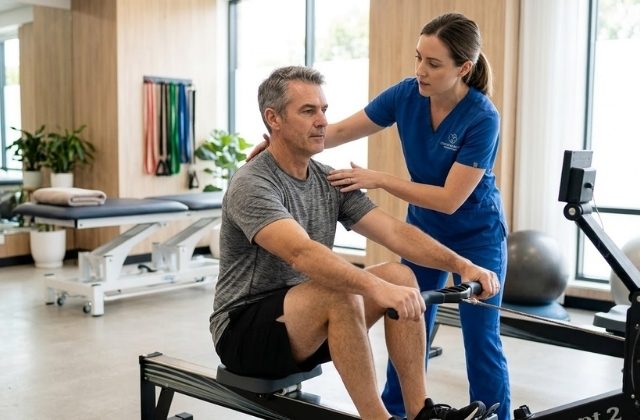
From a physiotherapy perspective, rowing is not just cardio. It is a controlled, full-body movement that can support injury recovery, improve movement patterns, and reduce strain on areas like the knees, back, and shoulders. When used correctly, it becomes a powerful low-impact cardio rehab tool.
What Is Rowing Machine Exercise (Physio Perspective)
Rowing machine exercise follows a repeated movement cycle. Each stroke involves coordinated motion across multiple joints and muscle groups.
The 4 Phases of Rowing
1: Catch
You start in a compressed position. Knees bend. Hips flex. Arms stay straight. The spine should remain neutral.
2: Drive
You push through your legs first. Then the hips extend. Arms stay relaxed until the end. This is where most power comes from.
3: Finish
Legs stay extended. You lean slightly back from the hips. Arms pull the handle to your torso.
4: Recovery
You reverse the movement. Arms extend first. Then the hips hinge forward. Knees bend last to return to the catch.
Joint and Muscle Involvement
Rowing uses:
- Hips → main power generator
- Knees → load transfer
- Spine → stability
- Shoulders → controlled pulling
Key muscles:
- Glutes and hamstrings (posterior chain)
- Core stabilisers
- Upper back muscles
This is why rowing machine exercise is considered a full-body, coordinated movement rather than isolated training.
If exercises alone are not enough, our physiotherapists in Bondi Junction and Maroubra can assess your condition and tailor treatment to your needs.
Why Physios Recommend Rowing Machines
Rowing stands out because it allows controlled loading across the body without impact. Here are some key benefits:
Low-impact cardio: There is no ground impact. This reduces stress on joints compared to running.
Full-body conditioning: You train strength and endurance together. This supports both rehab and performance.
Controlled movement: Unlike free weights or running, rowing allows precise control of speed and load.
Rehab-friendly progression: You can adjust resistance, stroke rate, and range of motion.
Common Injuries Linked to Poor Rowing Technique
Rowing is generally safe. Issues start when movement control breaks down. Small technique errors repeated over time can overload specific joints and tissues.
Lower Back Pain
Lower back pain often develops when the spine rounds during the catch instead of hinging at the hips. This repeated lumbar flexion places unnecessary stress on spinal structures, especially under load.
Shoulder Pain
The shoulder irritation & shoulder pain usually come from pulling too early with the arms rather than driving through the legs. Poor control of the shoulder blades also increases strain, leading to overload in the front of the shoulder.
Knee Pain
Runners knee discomfort can occur when there is too much compression at the catch or when the load is not evenly distributed through the legs. This places excess pressure on the front of the knee, especially with higher resistance or volume.
Wrist and Forearm Strain
Tension in the wrists and forearms often comes from gripping the handle too tightly or using an inefficient handle path. This creates unnecessary strain in the smaller muscles of the forearm instead of distributing the load through the larger muscle groups.
Who Should Use a Rowing Machine
Rowing suits a wide range of people across Sydney.
- Gym users (Bondi Junction): Great for cross-training and reducing joint stress.
- Runners with knee pain: Maintain cardio without impact loading.
- Office workers: Improves posture and reverses prolonged sitting patterns.
- Older adults (Maroubra): Safe, controlled movement for strength and mobility.
Physio Tips to Improve Rowing Performance
- Breathing control: Exhale during the drive. Stay relaxed during recovery.
- Stroke rate vs power: Focus on strong, controlled strokes rather than speed.
- Mobility: You need hip mobility and thoracic spine rotation.
- Strength base: Strong glutes and core improve efficiency and reduce injury risk.
How Physio Can Help?
At Invigor Health, rowing is used as part of a structured rehab and performance plan. We focus on:
- Movement screening to identify weak links
- Technique correction to reduce overload
- Personalised rehab programs
- Injury prevention strategies
Our approach combines:
- Hands-on treatment
- Exercise-based rehab
- Long-term strength development
You can explore our sports physiotherapy programs and movement screening assessments in Sydney to improve how you move and train.
If exercises alone are not enough, our physiotherapists in Bondi Junction and Maroubra can assess your condition and tailor treatment to your needs.
Book a Physio Session in Sydney
If you are using a rowing machine and dealing with pain, or you want to improve your technique, the right guidance makes a real difference.
Bondi Junction Clinic:
Ideal for active individuals, athletes, and gym users who want to optimise performance, improve rowing technique, and stay injury-free with expert physiotherapy Bondi support.
Maroubra Clinic:
Focused on recovery, this clinic supports post-injury and post-surgical patients with structured programs through rehabilitation physio at Maroubra, helping you return to movement safely.
Book a session with Invigor Health and learn how to use rowing correctly, improve movement quality, and build long-term resilience.
Exercise For You
Strengthening Exercises
Flexibility and Mobility Exercises
Stability and Balance Exercises
Rehabilitation and Injury-Specific
Posture and Core Activation
Neurological Rehabilitation Exercises
- Rowing Machine
- Tai Chi for Balancing
- Heel-to-Toe Walking
- Motor Control Exercises
- Coordination Drills
Post-Surgical Rehabilitation
- Shoulder External Rotation
- Hip Replacement Exercises
- Knee Replacement Rehabilitation
- Ankle Mobilizations
Breathing and Relaxation Exercises
- Diaphragmatic Breathing
- Pursed Lip Breathing
- Box Breathing
Pilates and Stability Exercises
- Pilates Leg Circles
- Pilates Roll-Ups
- Plank Variations
- Bridge with Marching