Dead Bugs (Core Stability)
The dead bug exercise is a controlled bodyweight exercise commonly used in physiotherapy to improve core muscle control, spinal stability, and coordinated movement. It is frequently prescribed during rehabilitation programs because it trains the core without placing excessive load on the spine.
At Invigor Health, our expert physio in Bondi Junction uses this dead bug exercise to support people managing back pain, recovering from injury or surgery, or rebuilding movement control after periods of reduced activity. Unlike high-load abdominal exercises, dead bugs focus on maintaining a neutral spine while the arms and legs move independently, making it a valuable rehabilitation exercise rather than a strength challenge.
What Is the Dead Bug Exercise
The dead bug exercise is a core control exercise performed lying on the back in a supine position. The arms and legs move in a slow, alternating pattern while the trunk remains stable.
The name comes from the starting position, which resembles a bug lying on its back with arms and legs raised. Despite the simple appearance, dead bugs require precise coordination between the core muscles, breathing, and limb movement.
Unlike crunches or sit-ups, which involve repeated spinal flexion, the dead bug exercise trains the body to resist movement through the spine. The goal is not to lift or curl the torso, but to maintain stability while the limbs move. This emphasis on control and coordination makes dead bugs particularly relevant for rehabilitation and injury prevention.
If exercises alone are not enough, our physiotherapists in Bondi Junction and Maroubra can assess your condition and tailor treatment to your needs.
When Is the Dead Bug Exercise Used
The dead bug exercise is commonly prescribed by physiotherapists and chiropractors as part of structured rehabilitation and conditioning programs.
Clinical use cases include:
- Back pain management, particularly when spinal stability or motor control is reduced
- Injury recovery, including lower back, hip, and post-surgical rehabilitation
- Core weakness, especially when traditional abdominal exercises are not appropriate
- General conditioning programs focused on movement quality
- Athletes in sports such as cycling, where sustained trunk control is required
Dead bugs are often selected as a low-force alternative to crunches and planks. They allow patients to develop core control without excessive spinal compression or fatigue. For this reason, the exercise is frequently included in clinical Pilates and early-stage rehabilitation programs.
Muscles Worked in Dead Bug
The dead bug exercise targets multiple muscle groups that work together to stabilise the spine and pelvis.
- Rectus abdominis
Provides anterior trunk support and helps control spinal position. - Internal and external obliques
Assist with rotational control and resist unwanted movement as opposite limbs move. - Transverse abdominis
Acts as a deep stabilising muscle that supports spinal stiffness and pressure control. - Multifidus
Contributes to segmental spinal stability, particularly in the lower back. - Erector spinae
Helps maintain neutral spinal alignment during limb movement. - Pelvic floor
Works with deep abdominal muscles to support pressure regulation and trunk stability.
Rather than isolating one muscle, the dead bug exercise trains these muscles to work together as a coordinated system. This integrated activation is why dead bugs are commonly used in rehabilitation rather than traditional abdominal workouts.
How to Perform the Dead Bug Exercise (Step by Step)
- Lie on your back in a supine position on a mat.
- Settle into a neutral spine, maintaining the natural curvature of your lower back rather than flattening or arching excessively.
- Lift both legs into a table-top position, with hips and knees bent to approximately 90 degrees.
- Raise both arms so they point towards the ceiling.
- Slowly extend one leg away from the body while simultaneously lowering the opposite arm overhead.
- Keep the movement controlled and return to the starting position.
- Alternate sides while maintaining spinal stability.
Clinical cues commonly used by physiotherapists include:
- Keep the ribs relaxed and avoid flaring
- Maintain even breathing throughout the movement
- Move slowly and deliberately
- Stop before any loss of spinal control
The exercise should feel controlled and stable. It should not cause pain.
Technique Errors and Common Mistakes
Several common errors can reduce the effectiveness of the dead bugs exercise or increase strain.
Loss of neutral spine
Arching or flattening the lower back reduces core engagement and increases spinal stress.
Rushing the movement
Speed often replaces control, limiting neuromuscular coordination.
Holding the breath
Breath-holding disrupts pressure control and reduces deep muscle activation.
Overextending the arms or legs
Moving beyond the point of control places unnecessary load on the spine.
Poor pelvic control
Pelvic movement indicates reduced core stability and compensatory strategies.
Each of these errors shifts the exercise away from controlled rehabilitation and towards inefficient movement patterns.
Dead Bug Exercise for Beginners
In a clinical context, a beginner is not defined by fitness level alone. Beginners may include people recovering from injury, returning to exercise after surgery, or those with reduced movement control.
The dead bug exercise is highly modifiable, making it appropriate for early rehabilitation stages. It should be introduced gradually, with emphasis on control rather than range or difficulty.
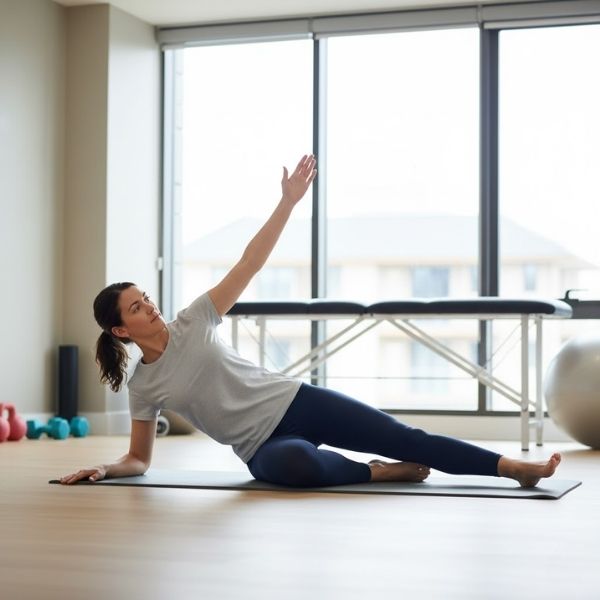
If exercises alone are not enough, our physiotherapists in Bondi Junction and Maroubra can assess your condition and tailor treatment to your needs.
Beginner Modifications
Common modified dead bug exercise options include:
- Keeping the feet on the ground rather than lifting both legs
- Reducing the range of movement of the arms or legs
- Using foot taps instead of full leg extension
- Moving one limb at a time rather than the opposite arm and leg
- Shortening lever length by bending the arms or knees
Each modification reduces the demand on spinal stability while still training core control. Physiotherapists select these options based on symptoms, movement quality, and rehabilitation stage.
Dead Bug Exercise Progressions
Progressions should only be introduced once control is maintained throughout the movement.
Progression options may include:
- Increasing lever length by fully extending limbs
- Slowing the tempo to increase time under tension
- Introducing pauses or holds
- Adding external load conceptually, such as light resistance, under supervision
Progression is most effective when guided by a physiotherapist, ensuring movement quality is maintained and symptoms remain controlled.
Safety and Guidelines
The dead bug exercise should not cause pain. Mild muscle effort is expected, but discomfort in the back, hips, or neck is not.
Stop the exercise if:
- Pain develops during or after movement
- Control of the spine cannot be maintained
- Symptoms worsen with repetition
Seek physiotherapy assessment if pain persists or if the exercise feels difficult despite modification. Early supervision helps ensure correct technique and appropriate progression.
In physiotherapy clinics in Bondi Junction, dead bugs are commonly prescribed as part of supervised rehabilitation programs. They are frequently included following movement screening, particularly when deficits in core control or coordination are identified.
At Invigor Health, exercises such as the dead bug are selected based on individual assessment findings. They are used within tailored, evidence-based programs that aim to restore movement quality, reduce strain, and support long-term injury prevention.
If exercises alone are not enough, our physiotherapists in Bondi Junction and Maroubra can assess your condition and tailor treatment to your needs.
Exercise For You
Strengthening Exercises
Flexibility and Mobility Exercises
Stability and Balance Exercises
Rehabilitation and Injury-Specific
Posture and Core Activation
- Pelvic Tilts
- Dead Bugs
- Superman Exercise
- Bracing Techniques
- Cobra Stretch
Cardiovascular Rehabilitation Exercise
- Low-Impact Walking
- Cycling
- Swimming
- Rowing Machine
Neurological Rehabilitation Exercises
- Tai Chi for Balancing
- Heel-to-Toe Walking
- Motor Control Exercises
- Coordination Drills
Post-Surgical Rehabilitation
- Shoulder External Rotation
- Hip Replacement Exercises
- Knee Replacement Rehabilitation
- Ankle Mobilizations
Breathing and Relaxation Exercises
- Diaphragmatic Breathing
- Pursed Lip Breathing
- Box Breathing
Pilates and Stability Exercises
- Pilates Leg Circles
- Pilates Roll-Ups
- Plank Variations
- Bridge with Marching