Rotator Cuff Exercises (For shoulder injury recovery)
Shoulder pain is one of the most common reasons people search for rotator cuff exercises. It often builds slowly from gym training, desk work, swimming, or repetitive overhead use. In other cases, pain follows a specific incident or surgery. Whatever the cause, most people want the same thing: safe movement, reduced pain, and a clear way to regain strength without making the shoulder worse.
Here are some practical exercises for rotator cuff injury, focusing on controlled movement, gradual loading, and symptom management. The goal is not to rush recovery, but to restore confidence in your shoulder step by step.
Before you start any rotator cuff rehab
If you are dealing with shoulder pain & rotator cuff injury, how you exercise matters more than how hard you exercise.
Pain rules
Keep pain at a mild level. Aim for discomfort no higher than 3 out of 10. Pain should not spike sharply and should settle back to normal within 24 hours. If pain lingers or worsens the next day, scale back.
Frequency
Mobility and stretching can be done daily. Strength work is usually best on 3 to 4 days per week to allow recovery.
Warm-up
A short walk, gentle arm swings, or heat for a few minutes helps calm the shoulder before starting.
What’s normal
A gentle stretch, light muscle fatigue, or mild ache during healing rotator cuff exercises.
What’s not
Sharp pain, catching, sudden weakness, or pain that builds with every repetition.
If you are post-surgery, follow your surgeon’s timeline first. Some safe exercises with rotator cuff injury are delayed early on for good reason.
Understanding rotator cuff pain and recovery
The rotator cuff muscles help centre the shoulder joint during movement. When these muscles lose strength or coordination, everyday actions like lifting, reaching, or sleeping on your side can hurt.
Rotator cuff pain is not always a sign of a tear. Many patients are dealing with tendon overload, stiffness, or poor shoulder blade control. That is why effective rehab exercises for the rotator cuff focus on:
- Restoring range of motion
- Improving shoulder blade control
- Gradually rebuilding strength
This approach supports people trying to heal a torn rotator cuff naturally when appropriate, while also protecting those who need formal rehab.
If exercises alone are not enough, our physiotherapists in Bondi Junction and Maroubra can assess your condition and tailor treatment to your needs.
Here is a proper step-by-step approach to be followed:
Phase 1: Relief and mobility
Pendulum swing
This exercise is used early to reduce pain and encourage gentle shoulder movement without loading the rotator cuff. Support yourself with a table or chair using your unaffected arm. Lean forward slightly and allow the affected arm to hang freely. Use your hips and legs to create motion so the arm swings naturally, rather than lifting it with the shoulder muscles. Start by swinging forward and backward, then progress to small circular movements about the size of a dinner plate. Perform this for around one minute, at least three times per day. The arm should stay relaxed throughout. Avoid actively lifting the arm or making large circles too early. As pain settles, the size of the circles can gradually increase.
Posterior shoulder stretch
This stretch helps reduce tightness across the back of the shoulder, which often contributes to rotator cuff pain. Relax your shoulders and gently pull the affected arm across your body using the opposite hand until you feel a controlled stretch at the back of the shoulder. Hold the position for 15 to 30 seconds and repeat two to four times. The stretch should feel steady and comfortable. Avoid shrugging the shoulder or forcing the arm further than it naturally allows.
Up-the-back shoulder stretch
This exercise focuses on restoring behind-the-back movement and is often introduced later in rehabilitation. Begin by resting the hand of the affected arm in your back pocket and allowing the shoulder to relax. As mobility improves, you can gently assist the movement by pulling the wrist upward with the opposite hand. More advanced versions use a towel to guide the arm higher behind the back. Hold each stretch for 15 to 30 seconds and repeat two to four times. This stretch is commonly delayed after surgery or significant injury and should only be progressed if symptoms remain settled.
Shoulder extensor stretch (supported)
This stretch improves shoulder extension and general flexibility. Hold a stable surface such as a bench, counter, or chair. With arms straight, bend forward slightly and allow the shoulders to stretch as your upper body lowers. Keep the movement slow and controlled. Hold for 15 to 30 seconds and repeat two to four times. The stretch should feel gentle and even through both shoulders, without sharp pain.
Phase 2: Control and coordination
Shoulder blade squeeze
This exercise improves shoulder blade positioning, which is essential for reducing strain on the rotator cuff. Sit or stand upright with arms relaxed by your sides. Gently draw your shoulder blades down and together, hold briefly, then relax. The movement should feel controlled rather than forced. Hold for around six seconds and repeat eight to twelve times. Avoid lifting or shrugging the shoulders during the squeeze.
Scapular arm reach (lying)
This exercise trains shoulder blade movement without placing heavy load through the shoulder joint. Lie on your back with your arms pointing straight up toward the ceiling. Keeping the elbows straight, reach upward so the shoulder blades lift slightly off the floor, then slowly lower back to the starting position. The movement should come from the shoulder blades rather than the arms. Perform eight to twelve slow repetitions.
If exercises alone are not enough, our physiotherapists in Bondi Junction and Maroubra can assess your condition and tailor treatment to your needs.
Phase 3: Strength building
Arm raise to the side
This exercise builds shoulder strength while maintaining good control. Raise the affected arm slightly forward of the body, rather than directly out to the side, with the thumb pointing upward. Early on, stop below shoulder height to avoid unnecessary strain. Lower the arm slowly back to the side. Perform eight to twelve repetitions. As control improves and pain remains settled, light resistance such as a small dumbbell or water bottle can be added.
Isometric shoulder flexion
This is a low-load strengthening exercise used when shoulder movement is still sensitive. Stand facing a wall with the elbow bent to 90 degrees. Press a closed fist gently into the wall using about half of your available strength. Hold the contraction for around six seconds, then relax. Repeat eight to twelve times. The body should stay still throughout the hold.
Isometric shoulder extension
This exercise strengthens the back of the shoulder without moving through range. Stand with your upper arm against a wall and the elbow bent to 90 degrees. Press the elbow gently back into the wall and hold for around six seconds before relaxing. Repeat eight to twelve times. Keep the trunk steady and avoid leaning forward.
Resisted row
This exercise supports rotator cuff strengthening by improving shoulder blade control. Anchor a resistance band at waist height and hold one end in each hand. Start with arms extended in front of you, then pull the elbows back along your sides while gently squeezing the shoulder blades together. Return slowly to the starting position. Perform eight to twelve repetitions with controlled movement throughout.
Resisted shoulder internal rotation
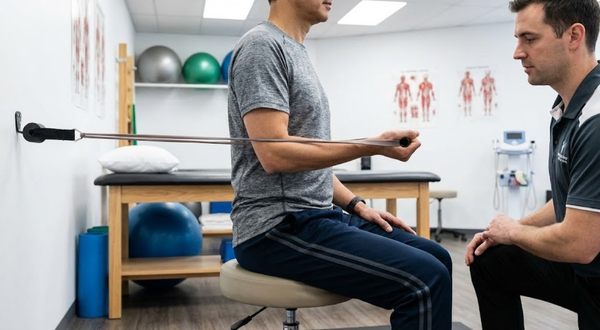
This exercise targets the rotator cuff muscles directly. Stand side-on to a resistance band anchored at waist height, keeping the elbow of the affected arm bent to 90 degrees and tucked into your side. Rotate the forearm inward toward the body against the band, then slowly return. Perform eight to twelve repetitions, keeping the elbow close to the body and the movement controlled.
Phase 4: Functional loading
Wall push-ups
Wall push-ups help prepare the shoulder for everyday tasks and gradual overhead loading. Stand facing a wall with your hands placed at shoulder height and your feet slightly away from the wall. Slowly bend your elbows to bring your chest toward the wall, then push back to the starting position. Perform eight to twelve repetitions with smooth, controlled movement. As strength improves, this exercise can be progressed to lower surfaces such as a bench or chair.
Progressing toward daily and overhead tasks
As strength improves, functional loading becomes important. Wall push-ups are a common starting point. They allow the shoulder to tolerate weight through the arms in a controlled way. Over time, the height can be lowered to increase demand, progressing from wall to bench, then to floor if appropriate.
This stage is often where people feel their shoulder becoming reliable again. For those returning to sport or work, this phase bridges the gap between rehab and full activity.
How long does rotator cuff rehab take?
Many people notice early improvements within two to four weeks when exercises are done consistently and within pain limits. Full recovery can take longer, particularly when returning to overhead sport or heavy lifting.
If symptoms flare, returning to earlier healing rotator cuff exercises is often more effective than pushing forward. Progress is rarely linear, and setbacks are part of recovery.
When to seek physiotherapy support
It is time to seek professional guidance if pain is not improving after a few weeks, if night pain continues to worsen, or if there is noticeable weakness or loss of function. Post-surgical patients should always have guided progression.
A physiotherapist can assess movement patterns, shoulder blade control, and load tolerance, and help refine shoulder exercises for rotator cuff injury to suit your specific situation.
Physiotherapy support at Invigor Health
Invigor Health provides physiotherapy services in Bondi Junction for rotator cuff injuries. Appointments are available both in person and via Telehealth, supporting people at all stages of shoulder rehabilitation
If exercises alone are not enough, our physiotherapists in Bondi Junction and Maroubra can assess your condition and tailor treatment to your needs.
Exercise For You
Strengthening Exercises
Flexibility and Mobility Exercises
Stability and Balance Exercises
Rehabilitation and Injury-Specific
- Rotator Cuff Exercises
- Knee Extension
- Ankle Pumps
- Hip Abductor Exercise
- Clamshell Exercise
- IT Band Stretch
- Patella Mobilizations
Posture and Core Activation
- Pelvic Tilts
- Dead Bugs
- Superman Exercise
- Bracing Techniques
- Cobra Stretch
Cardiovascular Rehabilitation Exercise
- Low-Impact Walking
- Cycling
- Swimming
- Rowing Machine
Neurological Rehabilitation Exercises
- Tai Chi for Balancing
- Heel-to-Toe Walking
- Motor Control Exercises
- Coordination Drills
Post-Surgical Rehabilitation
- Shoulder External Rotation
- Hip Replacement Exercises
- Knee Replacement Rehabilitation
- Ankle Mobilizations
Breathing and Relaxation Exercises
- Diaphragmatic Breathing
- Pursed Lip Breathing
- Box Breathing
Pilates and Stability Exercises
- Pilates Leg Circles
- Pilates Roll-Ups
- Plank Variations
- Bridge with Marching
Frequently Asked Questions
What are the best rotator cuff exercises for pain?
Gentle movement, shoulder blade control, and low-load strengthening are usually best. Exercises should reduce stiffness without increasing pain.
Can I do rotator cuff exercises if I have a torn rotator cuff?
Often yes. Many people can start with controlled movement and light strengthening, depending on symptoms and tear size.
How often should I do rotator cuff exercises?
Mobility exercises can be done daily. Strengthening is usually done three to four times per week.
How long does it take to heal a rotator cuff injury with exercises?
Early improvement is often seen within two to four weeks. Full recovery may take longer depending on severity and activity level.
Can exercises fix rotator cuff pain or impingement?
In many cases, yes. Improving movement control and strength often reduces symptoms significantly.